
The Question That Breaks Every Meeting
There's a question that stops healthcare CTOs cold:
“Can you show me, right now, that your application code handles patient data the way your compliance policies say it does?”
Not whether your cloud infrastructure is encrypted. Not whether your HIPAA policies exist. Not whether your team completed their annual training. Whether the actual source code - the functions and endpoints and database queries that touch patient data thousands of times a day - follows the rules your compliance documentation says it does.
In our experience, the honest answer is almost always: “I'd need to check with engineering.”
That answer reveals the most dangerous gap in healthcare compliance today. Not a gap in policy. Not a gap in infrastructure. A gap between what organizations document and what their software actually does.
Two Parallel Realities
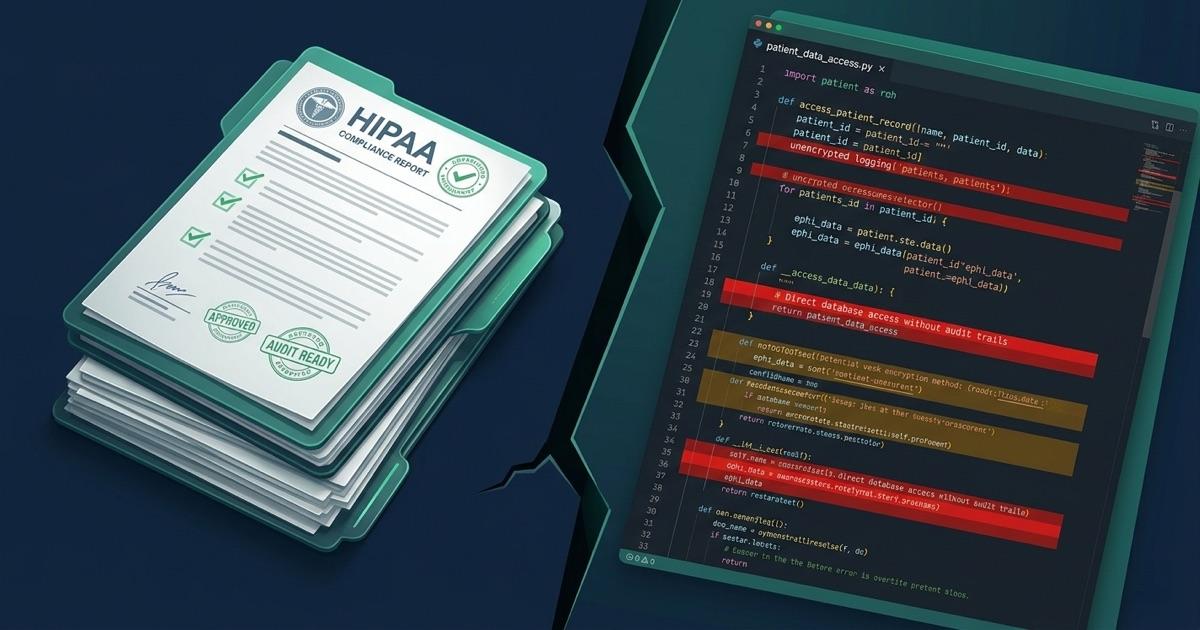
Healthcare organizations operate in two parallel realities that rarely intersect.
Reality 1: The Compliance World. Policies are written. Risk assessments are conducted. Training is completed. BAAs are signed. Auditors review documentation. Checklists are checked. Everything looks good on paper. The compliance team reports to the board that the organization meets HIPAA requirements.
Reality 2: The Code World. Developers write code. Features ship. Bug fixes go out. API endpoints are added. Database queries are modified. Log statements are written. Dependencies are updated. None of these changes are reviewed against the compliance policies from Reality 1.
These two worlds coexist peacefully until something goes wrong. A breach happens. An OCR investigation begins. An auditor asks to see not just the policy, but evidence that the policy is implemented in the actual systems that handle patient data.
That's when the gap becomes visible. And by then, it's too late to close it quietly.
Where the Gap Shows Up
The gap between compliance documentation and code reality shows up in predictable patterns. These aren't theoretical risks. They're patterns we see repeatedly when analyzing healthcare codebases.
Encryption policies vs. encryption reality
The policy says “all ePHI shall be encrypted at rest.” The infrastructure team enables encryption on the database. The compliance team checks the box. But in the application code, patient data is extracted from the encrypted database into plaintext variables, passed through unencrypted function calls, written to temporary files, cached in memory stores without encryption, and logged to third-party services.
The database is encrypted. The application layer is not. The policy is technically satisfied at one layer and completely violated at another.
Access control policies vs. access control reality
The policy says “access to ePHI shall be limited to authorized personnel with role-based access controls.” The infrastructure has IAM roles configured. But in the application code, API endpoints that return patient data don't verify whether the requesting user is authorized to access that specific patient's records. The route exists. The authentication middleware checks if you're logged in. But nobody checks if you should see this particular patient's data.
Logging policies vs. logging reality
The policy says “PHI shall not be stored in application logs.” But developers write error handlers that include patient context for debugging. A try-catch block logs the patient object when an operation fails. That log statement ships patient names, diagnoses, and contact information to whatever logging service the organization uses.
The policy says don't log PHI. The code logs PHI every time an error occurs.
Data minimization policies vs. data minimization reality
The policy says “only the minimum necessary PHI shall be accessed for any given purpose.” But the API returns the full patient object for every request because it was easier to build that way. A function that only needs a patient's name and appointment time receives their entire medical history.
-- Policy: "only the minimum necessary PHI shall be accessed"
-- Reality:
SELECT * FROM patients WHERE id = ?

-- What it should be:
SELECT name, appointment_time FROM patients WHERE id = ?
Why Annual Audits Don't Catch This
Traditional compliance audits weren't designed to examine source code. They were designed for a world where compliance meant physical safeguards, administrative procedures, and workforce behavior.
An auditor checks:
- Do you have policies? Yes.
- Is your infrastructure encrypted? Yes.
- Did your staff complete training? Yes.
- Do you have BAAs with your vendors? Yes.
- Do you have an incident response plan? Yes.
An auditor doesn't check:
- Does your Express.js route handler at line 47 of
patient-api.tsenforce role-based access before returning patient records? - Does your error handler at line 203 of
ehr-service.pyinclude patient diagnosis in the log message? - Does your database query at line 89 of
report-generator.javause column projection or does it fetch all fields including SSN?
The audit checks the policy. The security scanner checks for vulnerabilities. Nobody checks whether the code matches the policy.
This isn't a criticism of auditors. They're working within the scope they're given. The problem is that the scope hasn't evolved to include the application code layer - which is where patient data actually lives and moves.
The Proposed HIPAA Changes Signal Where This Is Heading
The proposed modifications to the HIPAA Security Rule include a requirement for regulated entities to maintain a “technology asset inventory and network map documenting the movement of ePHI through electronic information systems.”
Read that carefully. It's not asking for a policy document about how ePHI should move. It's asking for documentation of how ePHI actually moves through systems. That's a technical artifact, not a compliance binder.
Regulators are moving toward requiring evidence of implementation, not just documentation of intent. Organizations relying solely on policy documentation will scramble.
In India, DPDPA Section 8(3) requires “reasonable security safeguards,” with penalties up to INR 250 crore even without an actual breach. The mere failure to have adequate security measures is sufficient for enforcement action. GDPR Article 32 similarly requires “appropriate technical and organizational measures.”
In all three regulatory frameworks, the trend is the same: show us what your systems actually do, not what your policies say they should do.
Closing the Gap
The gap between compliance documentation and code reality isn't inevitable. It exists because the tools and practices for verifying compliance at the code level haven't been part of the standard healthcare compliance toolkit. That's changing.
Step 1: Map your data flows
Before you can verify compliance, you need to know where patient data goes. Not where it should go according to your architecture diagram. Where it actually goes in the code. Every entry point, every processing step, every storage location, every external transmission.
Step 2: Verify compliance continuously
Compliance isn't a point-in-time snapshot. Code changes every day. Compliance verification needs to run every time code changes - in the CI/CD pipeline, not once a year during audit season.
Step 3: Make the code the compliance evidence
Instead of maintaining compliance documentation separately from the codebase, generate compliance evidence from the code itself. Automated scan reports that show which regulatory controls are passing, which are failing, and where the gaps are.
The organizations that close this gap first will have a meaningful advantage: faster audits, lower risk, and compliance that's verifiable rather than aspirational.
Next Week
We're publishing the Compliance Security Index - the largest analysis of compliance in open-source healthcare software ever conducted. Over 3,000 repositories. Four compliance frameworks. The data shows exactly how wide the gap is between what healthcare software should do and what it actually does.
Stay tuned.