
The Comfortable Lie
Somewhere in your organization, there's a SharePoint folder called “HIPAA Compliance” or “Compliance Documentation.” Inside it are policies, procedures, risk assessments, training certificates, and BAA templates. They were written once, reviewed annually, and signed by people who may or may not have read them.
This is what most healthcare organizations call a compliance program.
It's also why OCR fines keep climbing, why breaches keep happening in organizations that “passed” their compliance review, and why the gap between documented compliance and actual compliance keeps widening.
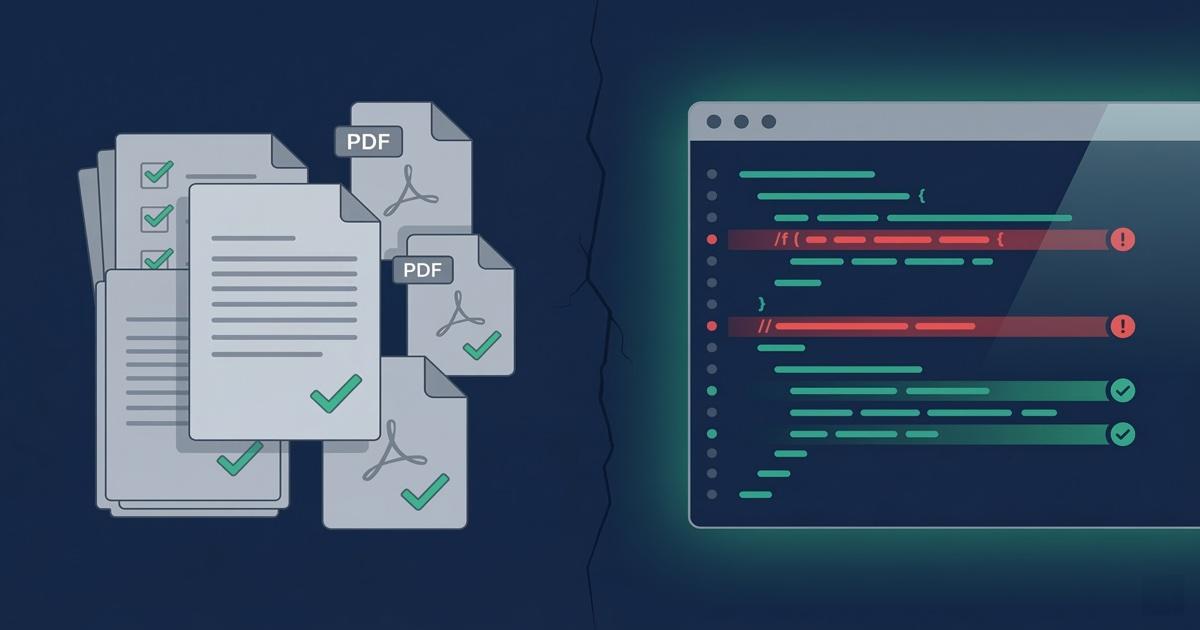
The uncomfortable truth: compliance documentation describes what should happen. Code determines what actually happens. And in almost every healthcare organization, those two realities don't match.
Documentation Says One Thing. The Code Does Another.
Here's a scenario that plays out in healthcare organizations every day.
The policy says: “All ePHI shall be encrypted at rest using AES-256 encryption.”
The database has encryption enabled at the infrastructure level. The compliance team checks the box. The auditor sees the AWS RDS encryption setting and moves on.
Meanwhile, in the application code, a developer wrote this six months ago:
const patient = await Patient.findById(id);
logger.info(`Processing patient: ${patient.name}, DOB: ${patient.dob}`);
Patient name and date of birth are now sitting in Datadog's servers in plaintext. The infrastructure encryption is irrelevant because the application leaked PHI before it ever reached the encrypted database.
The compliance documentation is technically accurate. The infrastructure is technically encrypted. And the organization is technically in violation of HIPAA §164.530(j) because PHI is being written to application logs accessible to unauthorized systems.
This isn't a hypothetical. We scanned over 3,500 public healthcare repositories and found PHI in log outputs in 8.3% of all violations. It was the fifth most common finding. These are codebases built by teams that almost certainly have compliance documentation.
Why the Checkbox Model Fails
The traditional compliance model works like this: write policies, train staff, document controls, pass an audit, repeat annually. This model was designed for a world where compliance meant physical safeguards, administrative procedures, and workforce behavior.
It was never designed for software.
Software changes every day. A developer pushes code that handles patient data differently than it was handled yesterday. A new API endpoint is added. A logging library is updated. A database query is modified. Each change can introduce or resolve a compliance violation, and none of these changes are visible in the policy binder.
Annual audits check a point-in-time snapshot. They verify that your policies exist, that your training was conducted, and that your infrastructure meets certain standards. They do not read your source code. They do not trace how PHI flows from an API endpoint through your business logic to your database. They do not check whether your error handlers leak patient data into log files.
The result is a compliance program that's accurate on paper and wrong in production.
What OCR Actually Looks For
When the HHS Office for Civil Rights investigates a breach or conducts a compliance review, they don't just ask for your policies. They ask for evidence that those policies are implemented and enforced.
The proposed HIPAA Security Rule modifications make this even more explicit. Regulated entities will be required to maintain a “technology asset inventory and network map documenting the movement of ePHI through electronic information systems.” This isn't a policy document. It's a technical artifact that shows exactly where patient data enters, flows through, and rests within your systems.
If your compliance evidence is a folder of PDFs, you cannot produce this. If your compliance evidence includes automated scans of your codebase showing data flow traces, encryption status at every storage point, and audit logging verification, you can.
The direction of regulatory enforcement is clear: show us what your systems actually do, not what your policies say they should do.
The Three Layers of Real Compliance
Compliance documentation isn't worthless. It's necessary. But it's only one of three layers, and it's the weakest one.
Layer 1: Policy (What Should Happen)
Written policies, procedures, risk assessments, training programs. This is where most organizations stop. It answers the question: “What are the rules?” Every healthcare organization needs this layer, and most have it.
Layer 2: Infrastructure (What the Environment Enforces)
Cloud configuration, network security, access controls, encryption settings, backup procedures. Tools like Vanta, Drata, and Secureframe automate this layer. It answers the question: “Is the environment configured correctly?” Many healthcare organizations have this too.
Layer 3: Code (What Actually Happens to Patient Data)
Application-level compliance. How PHI is handled in source code, where it flows, whether it's encrypted at the application layer, whether it appears in logs, whether access controls are enforced in route handlers, whether consent is verified before processing. This answers the question: “Does the software behave the way the policies and infrastructure assume it does?”
Almost nobody has Layer 3. Your policies say PHI is encrypted. Your infrastructure has encryption enabled. But your code stores patient addresses in plaintext variables, passes them through unencrypted function calls, writes them to log files, and returns them in API error responses. Layers 1 and 2 are green. Layer 3 is red. And Layer 3 is where patient data actually lives.
What Real Compliance Looks Like
Real compliance isn't a state you achieve once a year during audit season. It's a continuous property of your system, verified every time code changes.
Compliance Checks Run in Your CI/CD Pipeline
Every pull request that touches patient data is automatically scanned for regulatory violations before it merges. A developer who adds a log statement containing PHI gets a failing check, not a finding in next year's audit.
Data Flow Mapping Is Automated, Not Manual
Instead of a manually drawn architecture diagram that becomes outdated the week after it's created, your data flow map is generated from the actual codebase. It shows real entry points, real processing nodes, real storage locations, and real encryption status. When the code changes, the map changes.
Compliance Evidence Is Generated from Code
When an auditor asks “how do you ensure PHI is encrypted at rest?”, the answer isn't “we have a policy.” The answer is a scan report showing every storage location in the codebase, the encryption status of each one, and the regulatory section it maps to.
Violations Are Fixed in Development
The cheapest time to fix a compliance violation is before it's deployed. The most expensive time is after an OCR investigation. Every violation caught in a code review is a violation that never makes it to production, never appears in an audit finding, and never becomes part of a breach notification.
The Math That Should Concern You
HIPAA penalties range from $137 to $68,928 per violation, with annual maximums up to $2,067,813 per violation category. These numbers were adjusted for inflation in 2023 and continue to increase.
The average cost of a healthcare data breach in 2024 was $9.77 million, according to IBM's Cost of a Data Breach report. Healthcare has been the most expensive industry for breaches for 14 consecutive years.
The cost of running a compliance scan on your codebase before every deployment is measured in seconds and dollars per month.
The question isn't whether you can afford code-level compliance scanning. It's whether you can afford not to.
Start With One Question
Look at your compliance program and ask a single question: “Can I prove, right now, that our application code handles PHI the way our policies say it does?”
If the answer is “yes, here are the automated scan results from this morning's deployment,” you have a real compliance program.
If the answer is “I think so, let me check with engineering,” you have a stack of PDFs.